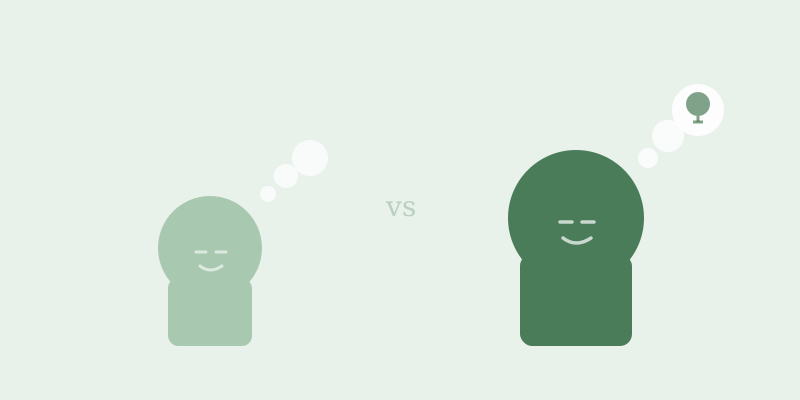
The common belief goes like this: children are sponges, adults are not. Kids learn languages overnight; adults struggle for years. Kids pick up instruments naturally; adults have to grind.
There's a kernel of truth in this. But the full picture is more nuanced — and significantly more encouraging if you're an adult trying to learn something new.
What children actually have
Children have certain genuine biological advantages for learning. Their brains have more neural plasticity, particularly for phonemic distinctions in language (which is why children can acquire accent-free speech in ways adults generally can't). They have more time, fewer responsibilities, and are immersed in their learning environment continuously.
These are real advantages. I'm not going to pretend otherwise.
But children also have enormous disadvantages that rarely get mentioned.
What adults have that children don't
Pre-existing knowledge to connect things to
Adults have a vast mental library of concepts, experiences, and frameworks. When you learn something new as an adult, you're not starting from nothing — you're connecting new information to a rich existing structure.
This is enormously powerful. An adult learning Spanish can use their knowledge of how grammar works, how communication works, and what they already know about the world. A child learning Spanish just has... Spanish.
The ability to use deliberate practice
Children learn largely through immersion and play. Adults can learn through deliberate, targeted practice — specifically identifying weak areas and attacking them directly. Research by Anders Ericsson (who developed the concept of deliberate practice) consistently showed that structured, intentional practice beats unstructured exposure for skill development.
Adults are better at this. Children can't sit down and decide to work on a specific problem area for 20 minutes. Adults can.
Motivation and context
Adults who choose to learn something are choosing to learn it. There's intrinsic motivation, a reason why, a context that gives the learning meaning. A child learning piano because their parents insisted has very different energy from an adult who has decided they want to play the songs they love.
Motivation matters enormously for learning. Adults often have more of it.
Self-awareness
Adults know when something isn't working. They can notice confusion, identify where understanding has broken down, and seek help or alternative explanations. They can regulate their own learning process in ways children cannot.
The one real obstacle: embarrassment
The biggest disadvantage adults face isn't cognitive — it's psychological. Adults are embarrassed to be beginners. We're not used to being bad at things. We have self-images and reputations to maintain.
This stops many adults before they even start, and causes many more to give up too early.
The antidote is simple in theory and hard in practice: accept that you will be bad at the start, recognise that this is normal and temporary, and keep going anyway. Every expert at anything was once a complete beginner. The gap between "terrible" and "decent" is shorter than it looks from outside, and the journey through it is actually enjoyable once you stop fighting it.
If you're an adult who has decided to learn something new, you have real advantages. Use them deliberately. And don't let the myth of the effortlessly learning child stop you from trying.