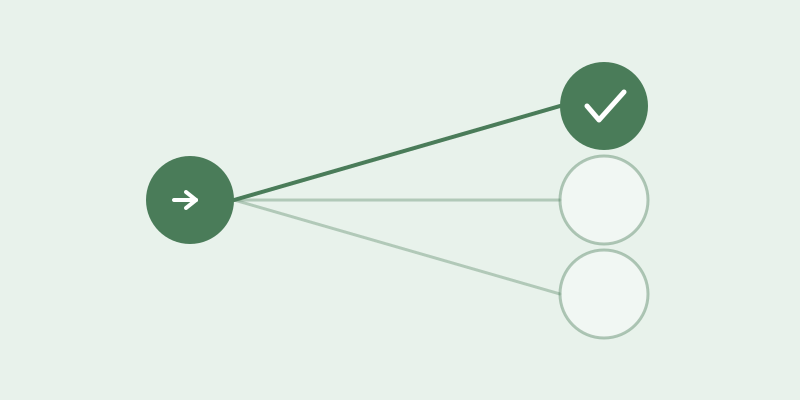
One of the most useful things I've learned about learning is that almost every skill is actually a collection of related but distinct sub-skills. And the one you choose to focus on has an enormous impact on whether you enjoy the process, make progress, and stick with it.
"Piano" is not a skill. "Jazz improvisation," "playing songs by ear," "reading sheet music," "classical technique" — those are skills. They overlap, but they're genuinely different, and a beginner who wants one of them should be learning quite differently from a beginner who wants another.
Getting specific isn't about limiting yourself. It's about giving yourself a clear path.
Why vague goals fail
A vague goal — "I want to learn Spanish" — creates a vague learning approach. You might download Duolingo, get a grammar textbook, sign up for evening classes, and watch Spanish films. All of these are different things that develop different aspects of Spanish. Without knowing what you actually want, it's easy to feel like you're doing a lot and going nowhere.
Worse, you'll measure your progress against the entire skill, which is essentially infinite, and always feel inadequate.
A specific goal — "I want to be able to hold a basic conversation about everyday topics" — tells you almost exactly what to practise. Listening and speaking. Common vocabulary. Pronunciation. Enough grammar to get by. You can make a plan. You can measure progress.
How to find your sub-skill
Ask yourself these questions:
What outcome do I actually want? Don't think about what you think you should want, or what would be most impressive. What would feel genuinely satisfying? Playing a song at a dinner party? Being able to chat to locals on holiday? Winning at your club? Understanding the rules well enough to enjoy watching it?
Who do I admire in this space? Think of someone doing the thing you want to do. Not a world-class professional necessarily — someone whose level of skill you'd love to have. What specifically are they doing? That's a clue about the sub-skill you're after.
What's the closest thing to the end result? Early in learning, there's often a gap between what you're practising and what you want to do. A good sub-skill choice minimises this gap. If you want to play pop songs, practise pop songs — not scales in isolation. If you want to speak Spanish conversationally, speak Spanish as soon as possible — don't spend three months only reading.
A few examples
Piano: Are you drawn to classical? Jazz? Pop and contemporary? Playing from sheet music or by ear? With others or solo? Each of these is a different learning path.
Guitar: Acoustic strumming and chord songs; fingerpicking; electric and lead guitar; classical guitar — these are meaningfully different. The chord-strumming guitarist and the lead guitarist are developing different physical skills.
Spanish: Conversational fluency, reading literature, understanding films and TV, business communication. The vocabulary and practice you need differs significantly.
BJJ: Within the sport, do you want to compete? Train casually? Focus on self-defence? No-gi or with the kimono? Your answers shape how and where you should train.
It's fine to revise
Being specific at the start doesn't lock you in forever. Once you've made some progress on your chosen sub-skill, you'll have a much better-informed view of what you want to develop next. Many pianists start with pop and develop an interest in understanding harmony, which leads them toward jazz. Many Spanish learners start with conversation and eventually want to read as well.
Start specific. Broaden later if you want to. The mistake is starting broad and hoping it narrows naturally — it usually doesn't.