The most common reason people stop learning something isn't that it's too hard. It's that they run out of consistency before they get to the good part.
They practise four days in a row when the motivation is fresh, then miss a week when things get busy, then feel guilty about the gap, then quietly stop. This isn't a failure of discipline. It's a failure to understand how habits actually form — and how to set them up in a way that doesn't rely on willpower.
Willpower is the wrong tool
Willpower is a finite resource. It depletes across the day, and it's being drawn on constantly by your job, your family, your decisions. By the time you sit down in the evening to practise something, your willpower tank is often close to empty.
The goal is to make practising something you do automatically — like brushing your teeth — rather than something you have to decide to do each time. Decisions are the enemy of habits. Every time you have to ask "should I practise today?", you're burning willpower and creating an opportunity to say no.
Make it obvious, easy, and at a fixed time
Three things that research on habit formation consistently points to:
Obvious — your cue for practising needs to be visible. A guitar left on a stand in the living room gets played. A guitar in a case in the spare room rarely does. Your piano app should be on your phone's home screen, not buried in a folder. A language flashcard app should appear when you open your phone, not be something you have to remember to find.
Easy — the lower the friction to starting, the better. Don't require yourself to set up, prepare, or find equipment before you can start. If you play piano, leave the lid open. If you're learning Spanish, set up your app before you need it. The goal is to make "starting" as close to zero effort as possible.
Fixed time — "I'll practise when I get a chance" is a reliable path to not practising. A fixed time, even an imperfect one, is much better. "After the kids are in bed" is good. "Straight after dinner" is good. "Saturday morning before the rest of the house wakes up" is good. The specific time matters less than its consistency.
Start smaller than you think you should
Most people plan to practise for too long and then can't face starting.
If 20 minutes sounds like a reasonable session, start with a commitment of 10. Even 5. The goal at the beginning is not the amount of practice — it's the habit of showing up. A 5-minute session that happens is infinitely more valuable than a 30-minute session that doesn't.
There's a useful concept sometimes called "the two-minute rule": when forming a new habit, scale it down to something that takes two minutes to start. Not two minutes total — just two minutes to begin, after which you'll usually continue naturally. "I'll just sit at the piano" is easier to commit to than "I'll practise for 30 minutes." And most of the time, once you sit down, you play.
Missing once is fine. Missing twice starts a different habit.
You will miss days. That's fine — it's expected. The thing to avoid is missing twice in a row, because that's when "I missed a day" becomes "I'm someone who doesn't do this."
One missed session is a blip. Get back to it the next scheduled time and don't make a big thing of it. Two consecutive misses means you need to actively restart rather than just continue.
Track it simply
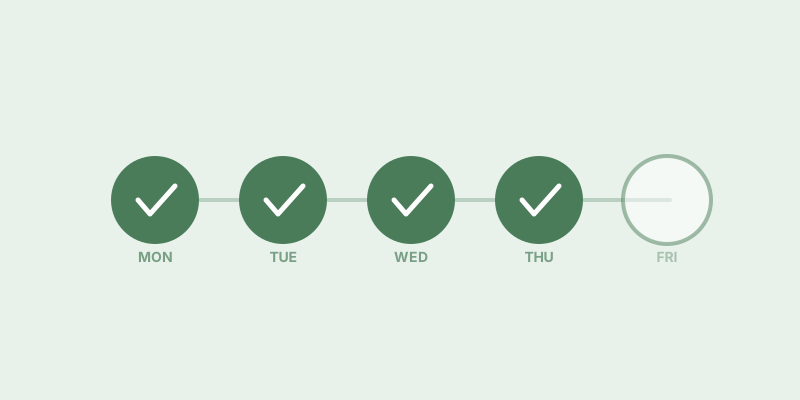
A simple visual tracker — crossing off days on a calendar, or using a habit app — is genuinely useful, not because of the data but because of the small psychological reward of the daily mark. It also makes gaps visible before they become long enough to matter.
Don't over-engineer this. A piece of paper on the fridge with boxes to tick is perfectly good.
The habit of practising is worth more than any particular technique or resource. Once it's established — usually after about six to eight weeks of consistency — you'll practise without thinking about it. Until then, give yourself every structural advantage you can.